







A4 Copy Paper 80GSM vs 75GSM: Which Is Better for Your Printing Needs?
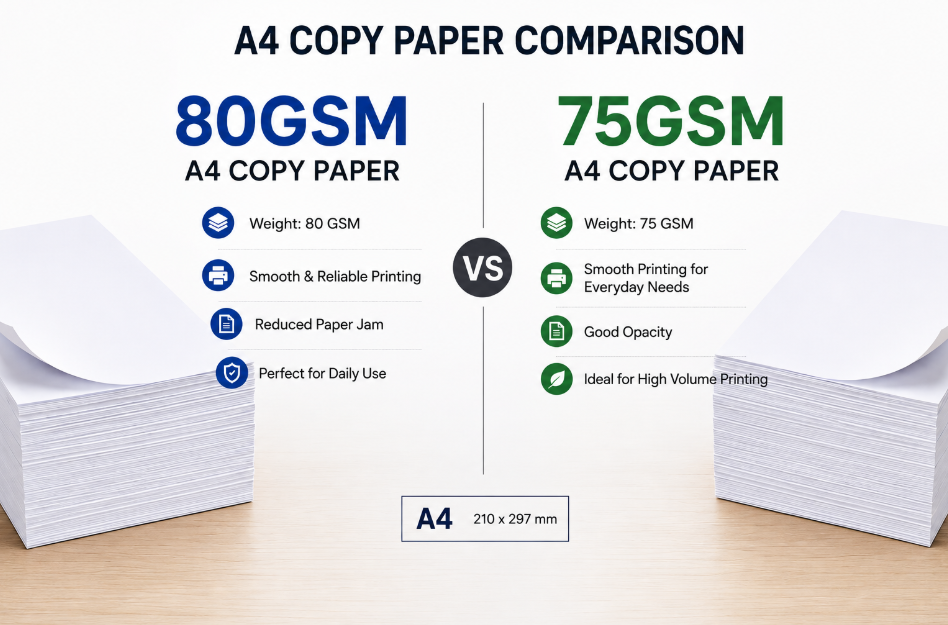
Table of Contents▼
- What Does GSM Mean in A4 Copy Paper?
- 75GSM vs 80GSM A4 Copy Paper at a Glance
- What Is 75GSM A4 Copy Paper?
- What Is 80GSM A4 Copy Paper?
- 80GSM vs 75GSM: Main Differences
- Does 80GSM Paper Print Better?
- Which Is Better for Double-Sided Printing?
- Which Paper Feels Better?
- 75GSM vs 80GSM for Different Applications
- Is 75GSM More Economical?
- What Other Paper Specifications Matter?
- How to Choose the Right A4 Copy Paper
- Tips for Buying A4 Copy Paper in Bulk
- Where to Source Wholesale A4 Copy Paper
- Frequently Asked Questions
- Conclusion
Choosing the right A4 copy paper may seem simple until you start comparing different paper weights. Among the most common options are 75GSM and 80GSM paper. Although the difference is only 5 grams per square metre, it can affect the way paper feels, handles, prints, and performs in different applications.
So, which should you choose: A4 copy paper 75GSM or 80GSM?
The answer depends on what you are printing, how frequently you print, whether you use both sides of the sheet, and how important paper feel and presentation are.
Generally, 75GSM A4 copy paper is a practical option for everyday and high-volume printing. Meanwhile, 80GSM A4 copy paper provides a slightly more substantial sheet and is often preferred for professional documents, reports, correspondence, and other applications where a heavier feel is desirable.
However, GSM is not the only factor that determines paper quality. Brightness, opacity, smoothness, thickness, fibre composition, moisture, and manufacturing consistency can also influence printing performance.
In this guide, we will compare 75GSM and 80GSM A4 copy paper in detail so you can make a more informed purchasing decision.
What Does GSM Mean in A4 Copy Paper?
GSM stands for grams per square metre.
It is a measurement used to describe the grammage of paper. In simple terms, it tells you how much a square metre of the paper weighs.
Therefore:
- 75GSM paper has a grammage of 75 grams per square metre.
- 80GSM paper has a grammage of 80 grams per square metre.
Because 80GSM has a higher grammage, it generally feels slightly heavier and more substantial than 75GSM paper.
However, it is important not to assume that a higher GSM automatically means better paper.
For example, a high-quality 75GSM paper can provide excellent printing performance, while a poorly manufactured 80GSM paper may not perform as well as expected.
Consequently, GSM should be considered together with other paper characteristics.
75GSM vs 80GSM A4 Copy Paper at a Glance
| Feature | 75GSM A4 Copy Paper | 80GSM A4 Copy Paper |
|---|---|---|
| Grammage | 75 g/m² | 80 g/m² |
| Weight | Lighter | Slightly heavier |
| Paper feel | Lightweight | More substantial |
| Typical use | Everyday and high-volume printing | General and professional printing |
| Draft printing | Excellent | Suitable |
| Office documents | Excellent | Excellent |
| Double-sided printing | Suitable, depending on opacity | Often preferred |
| Reports | Suitable | Excellent |
| Presentations | Suitable | Very suitable |
| Paper cost | Often economical | Often slightly higher |
| Handling | Lightweight | Firmer feel |
The difference may appear small, but it can become noticeable when handling a single sheet or a large stack of documents.
What Is 75GSM A4 Copy Paper?
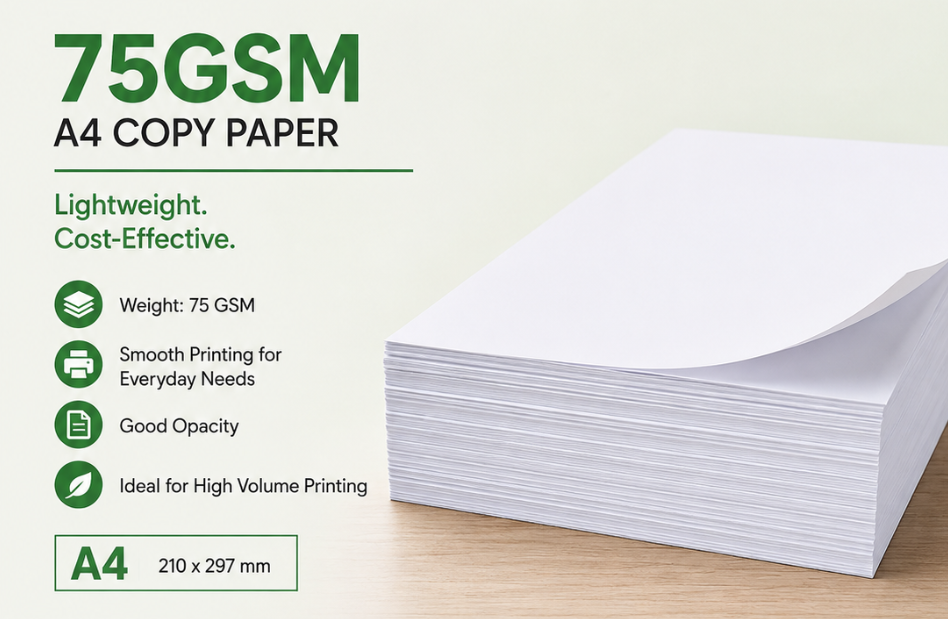
75GSM A4 copy paper is a lightweight paper commonly used for everyday printing and photocopying.
Because it uses slightly less material than 80GSM paper, it can be attractive for businesses and organizations that consume large quantities of paper.
For example, 75GSM paper can be suitable for:
- Internal office documents
- Drafts
- Worksheets
- Forms
- Notices
- Routine correspondence
- School documents
- High-volume photocopying
- Everyday administrative printing
One of the main advantages is efficiency.
If an organization prints thousands of pages every month, even a small difference in paper weight can become relevant when considering purchasing, storage, transportation, and handling.
Nevertheless, 75GSM should not be viewed simply as a lower-quality alternative to 80GSM.
A well-made 75GSM A4 copy paper can produce clear text and reliable results when it is matched with a compatible printer or copier.
The important consideration is whether its characteristics match the intended application.
What Is 80GSM A4 Copy Paper?
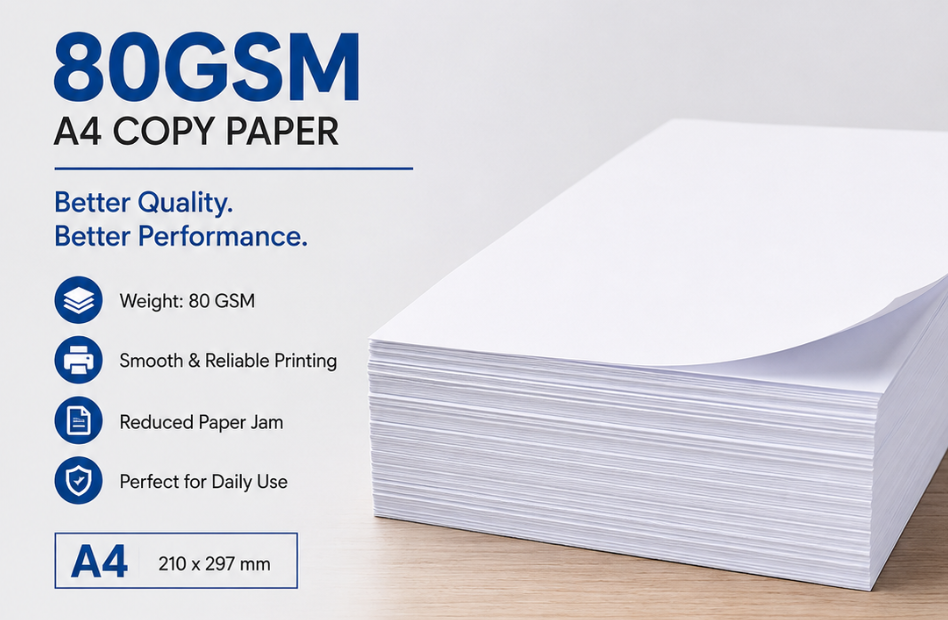
80GSM A4 copy paper is slightly heavier than 75GSM paper and is widely used for general office and professional printing.
The additional grammage gives the sheet a somewhat more substantial feel. As a result, many people prefer 80GSM for documents that will be handled, filed, presented, or printed on both sides.
Common uses include:
- Business reports
- Proposals
- Invoices
- Letters
- Presentations
- Contracts
- School and university assignments
- General office documents
- Double-sided documents
- Photocopying
However, choosing 80GSM does not automatically guarantee better print quality.
The printer, toner or ink, paper surface, moisture content, and manufacturing quality all contribute to the final result.
Therefore, when comparing two products, it is better to evaluate their complete specifications rather than looking at GSM alone.
80GSM vs 75GSM: Main Differences
1. Weight
The most obvious difference is weight.
80GSM paper is heavier than 75GSM paper because it has a higher grammage.
For an individual sheet, the difference is relatively small. However, when purchasing hundreds or thousands of reams, the difference becomes more significant.
This is particularly relevant for wholesalers, distributors, offices, schools, and other organizations that purchase A4 copy paper in bulk.
2. Feel
80GSM paper generally has a slightly firmer and more substantial feel.
This can be useful for documents that are intended to create a more professional impression.
For instance, a business proposal printed on 80GSM paper may feel more substantial than the same proposal printed on lighter paper.
By comparison, 75GSM paper has a lighter feel and can be perfectly adequate for documents that are primarily used internally.
3. Stiffness
Generally, heavier paper tends to have more body.
Consequently, 80GSM can feel slightly more rigid when held.
However, GSM should not be confused directly with thickness. Paper density and manufacturing processes can influence thickness and stiffness as well.
Therefore, two papers with the same GSM may not feel exactly the same.
4. Opacity
Opacity refers to how much light passes through the paper and, practically speaking, how visible printing from the opposite side is.
This becomes particularly important when you print documents on both sides.
An 80GSM sheet may provide a more substantial base for double-sided printing, but GSM alone does not determine opacity.
Paper composition and manufacturing quality also play important roles.
Therefore, if duplex printing is important to you, ask your supplier about the paper’s opacity and test samples before placing a large order.
5. Cost
75GSM paper can be an economical option for organizations that print large volumes.
However, the actual price difference depends on the manufacturer, brand, market, order size, packaging, and supplier.
As a result, it is better to compare the total value of the paper rather than assuming that 75GSM will always be cheaper.
Does 80GSM Paper Print Better?
Not necessarily.
This is one of the most important points to understand when comparing A4 copy paper.
A higher GSM does not automatically produce darker text, sharper images, or better colour reproduction.
Print quality is influenced by several factors, including:
- Paper surface
- Brightness
- Smoothness
- Opacity
- Ink or toner
- Printer technology
- Printer settings
- Paper moisture
- Paper manufacturing consistency
Therefore, a good-quality 75GSM paper can produce excellent results.
Likewise, a good-quality 80GSM paper can provide excellent results while offering a slightly heavier feel.
If you are selecting paper for a particular printer, the best approach is to test the actual product in that machine.
Which Is Better for Double-Sided Printing?
If you frequently print documents on both sides, 80GSM can be a good choice.
The heavier sheet may provide a more substantial feel and can be preferable for reports, business documents, presentations, and other materials that need to look good from both sides.
However, 75GSM can also be suitable for duplex printing when the paper has appropriate opacity and the printing application does not require a premium appearance.
For this reason, don’t make the decision based solely on GSM.
Instead, print a sample document on both sides and examine the result.
Pay particular attention to pages containing:
- Large areas of text
- Dark graphics
- Images
- Tables
- Bold headings
- Heavy toner coverage
If the printing from the opposite side is distracting, consider a paper with higher opacity or a heavier grade.
Which A4 Copy Paper Feels Better?
This largely comes down to personal preference and intended use.
80GSM generally feels more substantial when you hold it.
That can make it attractive for:
- Business reports
- Proposals
- Presentations
- Formal letters
- Customer-facing documents
- Important correspondence
On the other hand, 75GSM feels lighter and can be preferable when large quantities of documents need to be handled or stored.
For everyday internal documents, the difference may not matter at all.
75GSM vs 80GSM A4 Copy Paper for Different Applications
Everyday office printing
Both grades can work well.
However, if you want one general-purpose paper for a wide range of office applications, 80GSM offers a versatile option.
High-volume printing
75GSM can be attractive for high-volume printing because it is lighter.
For example, organizations producing large quantities of internal documents may not need the additional weight of 80GSM.
Business reports
80GSM is often a good choice for reports.
The slightly heavier sheet provides a more substantial feel and can be useful when documents are printed on both sides.
Drafts
For drafts and working documents, 75GSM can make sense.
There is often little benefit in using heavier paper for documents that will be reviewed and discarded.
School worksheets
75GSM can be suitable for worksheets and routine classroom materials, particularly when schools need to control paper costs.
Presentations
For customer-facing presentations, 80GSM may be preferable because of its more substantial feel.
However, if the presentation requires photographs or high-quality graphics, other paper characteristics may matter more than GSM.
Is 75GSM A4 Copy Paper More Economical?
It can be, particularly for high-volume users.
However, buyers should look beyond the price printed on a supplier quotation.
When purchasing A4 copy paper in bulk, consider:
- Price per ream
- Sheets per ream
- Reams per carton
- Cartons per pallet
- Shipping weight
- Freight charges
- Storage requirements
- Printing performance
- Reprinting caused by paper problems
For example, a slightly cheaper paper may not be the best value if it causes frequent paper jams or inconsistent results.
Therefore, the better question is:
Which paper gives me the lowest overall cost while providing the performance my application requires?
What Other A4 Copy Paper Specifications Matter?
GSM is only one specification.
Before buying A4 copy paper, you may also want to compare:
Brightness
Brightness affects how clean and bright printed material appears.
Higher brightness can make black text and graphics appear more distinct, although brightness specifications should be compared between products using the same measurement method.
Opacity
Opacity is particularly important for double-sided printing.
Higher opacity can reduce the visibility of printing from the other side.
Smoothness
Paper smoothness can influence how ink and toner interact with the sheet.
It can also affect how the paper feels when handled.
Thickness
Thickness is related to, but not identical to, GSM.
If the physical feel of the paper is important, ask suppliers for the relevant thickness specification.
Moisture
Paper can be affected by environmental conditions.
Excessive moisture can influence feeding, curling, and printing performance.
For this reason, proper packaging and storage are important.
Printer compatibility
Always check whether the paper is suitable for your printer, copier, or multifunction machine.
Different machines can have different recommended media weights and specifications.
How to Choose the Right A4 Copy Paper
A simple way to choose between 75GSM and 80GSM is to start with the purpose.
Choose 75GSM when:
- You print large volumes.
- Most documents are for internal use.
- You want a lightweight paper.
- Draft printing is common.
- Cost efficiency is important.
- A premium paper feel is not necessary.
Choose 80GSM when:
- Documents are customer-facing.
- You frequently print on both sides.
- You want a slightly more substantial sheet.
- You print reports and proposals.
- Professional presentation matters.
- You want a versatile general-purpose grade.
If you are still unsure, purchase samples of both and test them.
That is often the most reliable way to make the decision.
Tips for Buying A4 Copy Paper in Bulk
For wholesale and commercial buyers, purchasing paper is different from buying a few reams for an office.
Before placing a large order, request detailed information from the supplier.
Important questions include:
- What is the exact GSM?
- How many sheets are in each ream?
- How many reams are packed per carton?
- What are the paper’s brightness and opacity specifications?
- What printer types is the paper designed for?
- Is a product sample available?
- What brands or product lines are available?
- What packaging options are available?
- What are the minimum order quantities?
- What are the delivery and shipping terms?
Most importantly, compare samples before committing to a large shipment.
A sample allows you to test the paper in your actual printing environment instead of relying entirely on specifications.
Where to Source Wholesale A4 Copy Paper
Businesses that need A4 copy paper in larger quantities should compare suppliers based on more than price.
Product consistency, specifications, packaging, availability, order quantities, logistics, and customer support can all influence the overall value of a wholesale purchase.
For example, GTB International Papers, Thailand offers A4 copy paper products through its product range, making it one supplier that wholesale buyers can include in their evaluation. Buyers can review the available A4 copy paper range and then request current specifications and samples for the particular 75GSM or 80GSM product they are considering.
For more information, visit the GTB International Papers A4 copy paper category.
When evaluating GTB International Papers or any other wholesale supplier, ask for the exact product specifications rather than assuming that every 75GSM or 80GSM paper has identical characteristics.
For a large order, it is sensible to compare the sample, packaging, sheet count, technical specifications, pricing, and logistics before making a final decision.
Frequently Asked Questions
Is 80GSM better than 75GSM A4 copy paper?
Not automatically. 80GSM is heavier and generally feels more substantial, while 75GSM is lighter and can be an economical choice for high-volume printing. The better option depends on the intended application.
Is 75GSM good for office printing?
Yes. Good-quality 75GSM A4 copy paper can be suitable for everyday office documents, drafts, forms, worksheets, and routine printing.
Is 80GSM better for professional documents?
It can be a good choice because it has a slightly more substantial feel. However, overall paper quality, brightness, opacity, and smoothness also influence how professional a document looks.
Can I use 75GSM paper for double-sided printing?
Yes. Whether it performs well depends on the paper’s opacity, printer, ink or toner coverage, and document type. Testing a sample is the best way to determine whether it meets your requirements.
Does higher GSM mean thicker paper?
Not necessarily. GSM measures grammage rather than directly measuring thickness. Paper density and manufacturing characteristics can cause papers with similar GSM ratings to have different physical thicknesses.
Does 80GSM produce better print quality?
Not necessarily. GSM is only one paper specification. Printer technology, surface smoothness, brightness, opacity, ink or toner, and paper manufacturing quality can all affect print results.
Which is better for printing drafts, 75GSM or 80GSM?
75GSM is often a practical choice for drafts because drafts typically do not require a heavier or more substantial sheet.
Which is better for reports?
80GSM is often a suitable choice for reports, especially when they are printed double-sided or presented to customers, colleagues, or business partners.
Should businesses buy 75GSM or 80GSM in bulk?
It depends on the business’s applications. High-volume internal printing may favour 75GSM, while businesses that regularly print reports, proposals, and professional documents may prefer 80GSM.
What should I look for when buying A4 copy paper?
Look at GSM, brightness, opacity, thickness, smoothness, printer compatibility, sheet count, packaging, consistency, price, and supplier reliability. For large purchases, always test samples first.
Conclusion
The difference between 75GSM and 80GSM A4 copy paper may seem small, but the right choice can make a difference depending on how the paper is used.
75GSM is a practical option for high-volume printing, drafts, internal documents, worksheets, and other applications where lightweight and economical paper is appropriate.
80GSM, meanwhile, offers a slightly heavier and more substantial sheet. As a result, it can be particularly suitable for reports, proposals, professional correspondence, presentations, and many double-sided documents.
Nevertheless, there is no universal winner.
The best A4 copy paper is the one that provides the right combination of performance, appearance, reliability, and cost for your particular application.
If you are buying in bulk, don’t make your decision based solely on GSM or price. Compare the complete product specifications, obtain samples, test the paper in your printers, and evaluate the total purchasing and logistics costs.
For wholesale buyers, suppliers such as GTB International Papers, Thailand can be included in the comparison process. Request current product specifications and samples for the relevant A4 paper grades, then evaluate the products according to your customers’ actual requirements.
Ultimately, 75GSM is not simply “cheap paper,” and 80GSM is not automatically “better paper.” They are two different grades that can serve different purposes. Understanding those differences allows offices, businesses, distributors, and other buyers to choose their A4 copy paper more intelligently.
References & Further Reading
- A4 80GSM vs 75GSM: Which Copy Paper Wins? – Used as a reference when researching general differences between 75GSM and 80GSM A4 copy paper, including paper weight, duplex printing, opacity, handling, cost, and practical use cases.
- GTB International Papers – A4 Copy Paper – Product reference for wholesale A4 copy paper options.
